Tulsa FORTIFIED Roof™
Tulsa FORTIFIED Roof is a better way to protect your home against severe weather. After decades of studying weather-related damage, the Insurance Institute for Business & Home Safety (IBHS) developed the FORTIFIED™ program—a voluntary construction and re-roofing program designed to help protect homes against specific types of severe weather, such as high winds, hail, and hurricanes.
Homes meeting the rigorous requirements of the FORTIFIED Home™ —High Wind & Hail Roof Standards —may receive discounts on their homeowner’s insurance premium. Contact your insurance agent for discount details. View the current discounts here.
A FORTIFIED roof includes the following enhancements:
- Enhanced Roof Deck Attachment
- Sealed Roof Deck
- Locked Down Roof Edges
- Impact Resistant Shingles Rated by IBHS
- Wind and Rain-Resistant Attic Vents
Free Estimate
 Tulsa FORTIFIED Roofing Contractor Since 2018
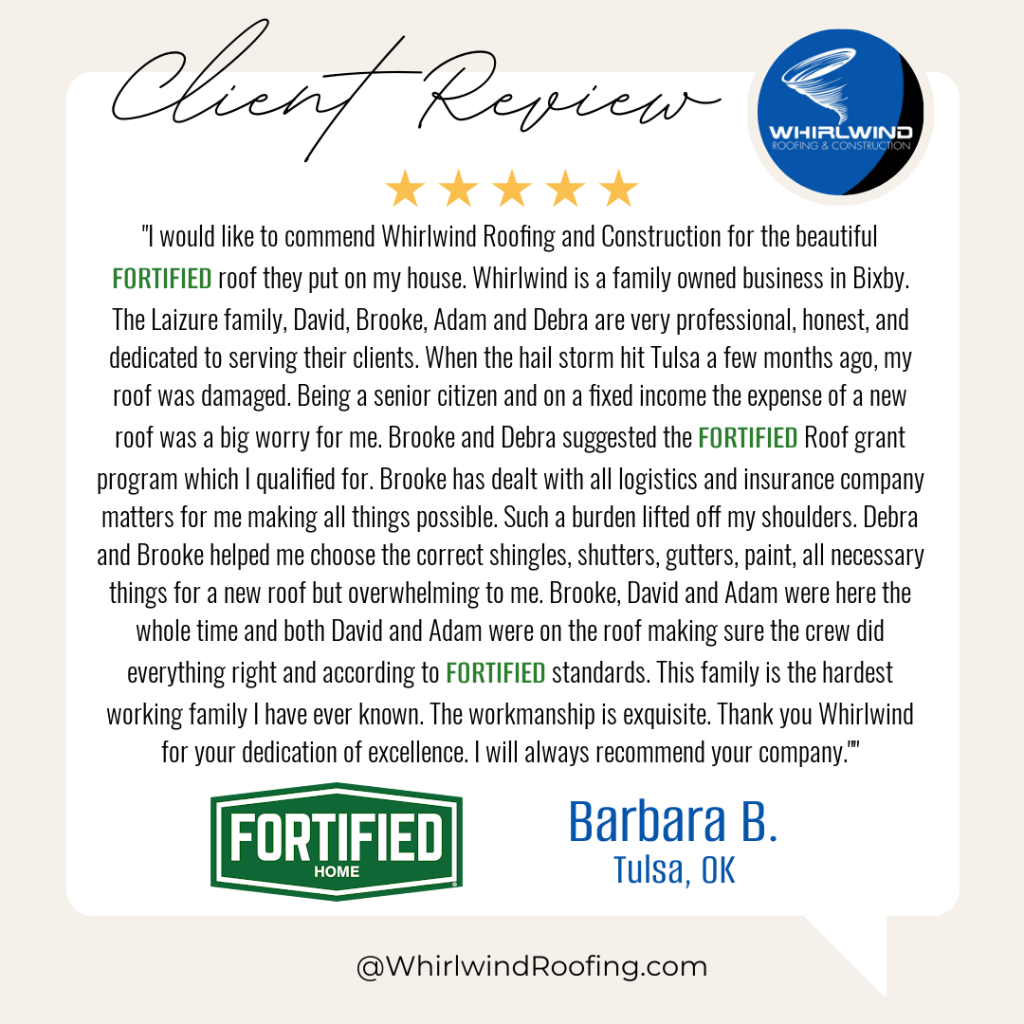
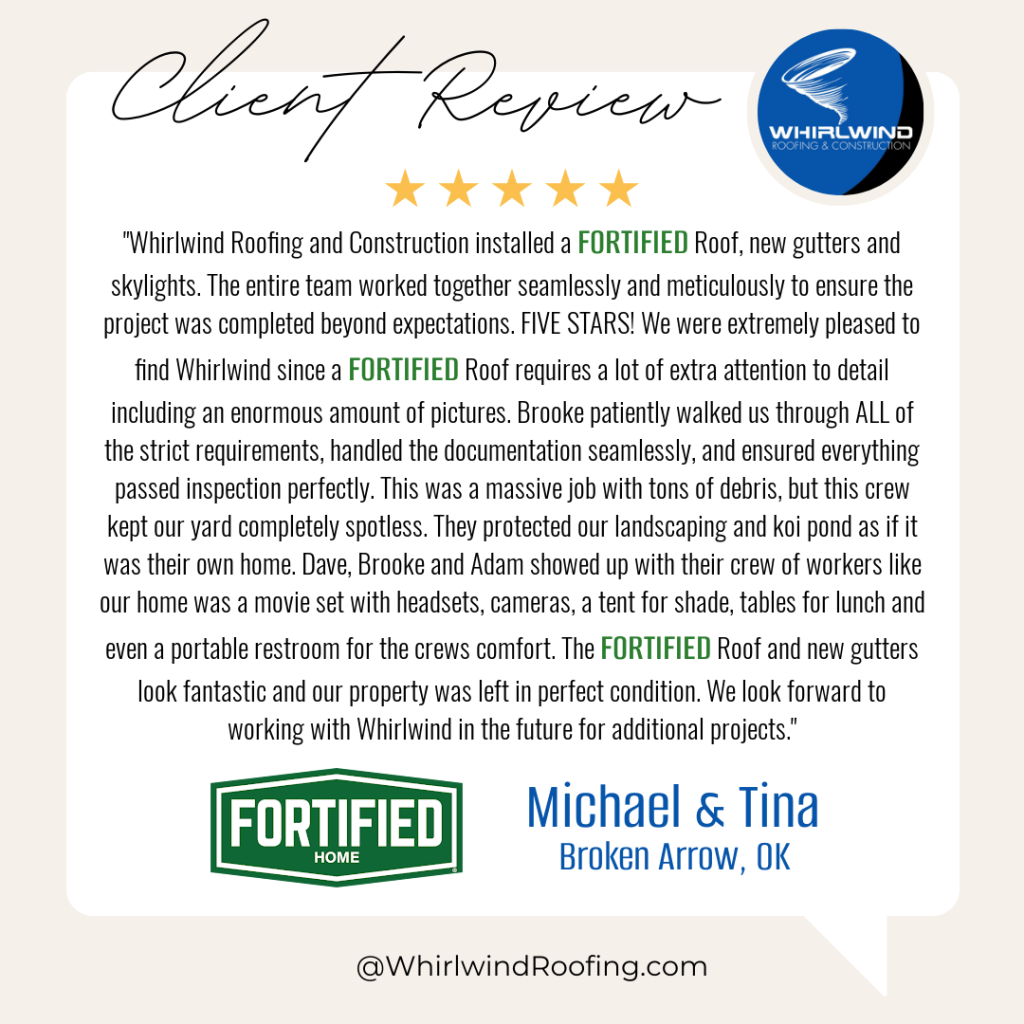
Whirlwind Roofing has been a FORTIFIED certified roofing contractor in Tulsa since 2018, helping Oklahoma homeowners strengthen their homes against severe weather. Choosing a FORTIFIED roof system during your next roof replacement adds an extra layer of protection where Oklahoma homes need it most. We are proud to be one of the eight original roofing contractors chosen for the OK Ready Strengthen Oklahoma Homes $10,000 grant program.
- Dave Laizure, co-owner of Whirlwind Roofing, has been an approved FORTIFIED roofer since 2018.
- Brooke Laizure, co-owner, became FORTIFIED certified in 2025 to help serve homeowners participating in the ever expanding OK Ready grant program.
- Both currently hold certifications for FORTIFIED Hail and FORTIFIED High-Wind.





Get $10,000 Toward a FORTIFIED Roof Through Oklahoma’s Grant Program
Step 1: Apply for the grant at Strengthen Oklahoma Homes
Step 2: Hire a third-party evaluator. (Contractors are not allowed to do the evaluation.)
Step 3: Once your application is approved, you’ll receive a list of approved contractors.
Why FORTIFIED Roof Bids Can Vary by Thousands of Dollars
A FORTIFIED roof is not just a roof replacement. It is a highly specific system that must meet strict engineering standards established by Insurance Institute for Business & Home Safety and verified by a third-party evaluator.
Because of that, two bids for a FORTIFIED roof can look similar on paper but differ significantly in materials, installation methods, and long-term performance.
Materials Included in the Bid Matter
Some lower bids may reduce cost by using materials that meet minimum requirements but may not offer the same durability.
For example:
- Box vents instead of continuous ridge vent systems
Box vents can lower cost initially, but they are more vulnerable to hail dents and do not provide the same balanced ventilation as a continuous ridge vent system. - Different shingle choices
Approved impact-resistant shingles vary in quality, warranty coverage, and long-term performance. - Lower-grade accessories
Flashings, starter materials, underlayments, and sealants all affect how well the roof performs in Oklahoma weather.
Installation Methods Can Greatly Affect Price
FORTIFIED roofing requires precise installation methods that often take more labor and attention to detail.
Examples include:
- Proper roof deck seam sealing
- Correct fastening patterns
- Enhanced drip edge installation
- Specialized flashing details around chimneys, valleys, and roof penetrations
Some contractors may choose faster methods that lower labor cost but may not provide the same long-term moisture control.
For example, applying full ice and water shield across the deck may seem efficient, but if ventilation is not carefully managed, it can create moisture concerns over time. In many cases, properly sealing deck seams is the better long-term solution.
Frequently Asked Questions
Is a FORTIFIED Roof more expensive than a traditional roof?
How does my roof receive FORTIFIED Roof certification?
Third-party verification by a FORTIFIED Evaluator is required to make certain the upgraded construction materials and installation methods used on your home meet the standards required for a FORTIFIED designation certificate. This is a service the homeowner pays for separately from the roofing contractor. A list of evaluators can be found at https://fortifiedproviders.com/
Is the FORTIFIED Roof certification good for the life of the roof?
Do I have to use a FORTIFIED roofing contractor or can I use my own roofing contractor?
Does having a FORTIFIED Roof qualify for insurance discounts?
Many insurers in Oklahoma offer discounts for homes meeting the FORTIFIED standards off the wind and hail portion of your homeowners premium. It is important to contact your insurance agent for discount details. View the current discounts here.
Will FORTIFIED prevent all damage to my home?
Is there grant money available for installing a FORTIFIED Roof?
Yes, the Strengthen Oklahoma Homes Act (SOH) provides a limited amount of grants to Oklahoma residents for residential wind and hail mitigation on new and existing, owner-occupied, primary residence single-family homes beginning in 2025. Funding for this program comes from the insurance industry in Oklahoma and is not funded from the state’s general budget. To receive this grant, you must obtain an IBHS FORTIFIED Home – Roof™ – High Wind designation with the Hail Supplement. Visit the OKReady website for the latest grant information.
Can the grant money be used toward my insurance deductible?
Can I use any FORTIFIED certified contractor for the grant money?
Why are my three FORTIFIED roof quotes so different in price?
- Box vents instead of continuous ridge vent systems
Box vents can lower cost initially, but they are more vulnerable to hail dents and do not provide the same balanced ventilation as a continuous ridge vent system. - Different shingle choices
Approved impact-resistant shingles vary in quality, warranty coverage, and long-term performance. - Lower-grade accessories
Flashings, starter materials, underlayments, and sealants all affect how well the roof performs in Oklahoma weather.
Installation Methods Can Greatly Affect Price
FORTIFIED roofing requires precise installation methods that often take more labor and attention to detail.
Examples include:
- Proper roof deck seam sealing
- Correct fastening patterns
- Enhanced drip edge installation
- Specialized flashing details around chimneys, valleys, and roof penetrations
Some contractors may choose faster methods that lower labor cost but may not provide the same long-term moisture control.
For example, applying full ice and water shield across the deck may seem efficient, but if ventilation is not carefully managed, it can create moisture concerns over time. In many cases, properly sealing deck seams is the better long-term solution.
What questions should I ask FORTIFIED roofing contractors?
Ask Every Contractor These Important Questions
- How many FORTIFIED roofs have you completed?
- How many have passed without correction?
- Who handles documentation for the evaluator?
- What ventilation system is included?
- How are roof deck seams sealed?
What happens if I sell my house during the grant approval process?
If a homeowner expects to close on the home before the 6-month grant eligibility window, it is advised to remain in the home until the grant process is finalized or to not to apply.
For example, if the home has been roofed, but not completely closed out by OK Ready/Strengthen Oklahoma Homes, and goes to closing, the grant applicant may become responsible for the full grant portion of the payment to the roofing contractor as they would no longer qualify for grant funds.